|
Comments on Taskin's Color
I am an equine-specialist sculptor who has made a study of horse colors and
color genetics, on my own time rather than by formal schooling, for about the
last thirty years.
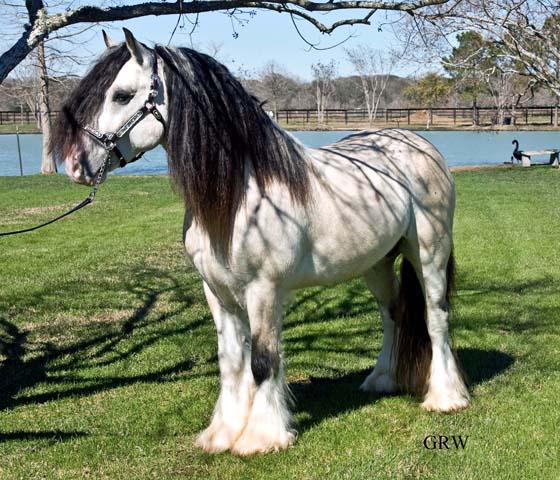
Taskin is a GORGEOUS horse, for starters! The dappling he shows in the top photo
on his page (around his elbows and up his barrel) is a sign of good health
common in bay-based horses.
He is NOT a champagne, as he does not have the grey freckles on pink skin that
are a major diagnostic for that dilute and his eyes do not appear to be hazel,
amber, gold, or green. He is NOT a dun, as he shows no dun factor markings,
which include: black horizontal leg bars, a dark, sharp-edged line down the
back, pale bars horizontally across the back of each ear just below the tip,
"fishbone" marks on the throat and chest, a dark nasal mask, "cob webbing" of
darker markings on the forehead, and a cross mark or dark cape at the withers.
Dun horses may have any or all of these marks but will have at least some of
them.
He IS a bay-based horse, probably a light or "sandy" shade. He IS a sabino
pinto, aka Blagdon in vanners, characterized by the blaze wrapping down onto his
chin and the white over one knee and up his hind legs. The white in his mane and
at his tail head is called "frosting" and is found on many bay-based crème
dilute horses (buckskin and perlino). I agree with everyone who says
"buttermilk" buckskin, also sometimes called "cream" buckskin.
I have little to offer in the way of references for my knowledge, save
Google-searching color terms, checking sites like doubledilute.com, and having
identified the stallion Cobalt, by Bob the Blagdon Horse, as a
maximum-expression sabino before his second birthday. Color and breeding testing
has evidently proven me correct with Cobalt, and I am fairly confident that
Taskin is a STUNNING buttermilk buckskin sabino.
Monique Hayes
The Silent Menagerie
Below are some comments on Taskin's coloring from our visitors.
About Your Buckskin Horse
Your horse is a Buckskin horse. A
Cremello will have white mane and a Dun will always have a dorsal stripe.
I used to raise buckskin geldings and the color looks more like a buttermilk.
The last time I had purchased some buckskin colts I thought they may have been a
cremello but after I had DNA testing completed they said they were buckskin
colts. Either way, Taskin is beautiful! Good luck, and I'll be back
to see your other buckskin horses.
Buckskin Stallions- Definitely Not
Chestnut Dear Sir,
You have asked for people to get in
touch with comments about that lovely Vanner's
colour and that is what I am doing. I have been learning about equine
colour genetics on-and-off for about a year now - specialising in the cream
dilutes - and I do believe that the people that have said that Taskin's not
a cremello or a dun are exactly correct. For him to be a cremello, all
pigment would be bleached - not only that but his base colour would be
chestnut and the dark points tell me that he is not
chestnut, his base colour is probably bay. As for dun, there is a
possibility but it's highly unlikely as he lacks a dorsal stripe - a
telltale sign of the 'lineback' gene. Then what is he? He definitely has the
creme gene to dilute his base colour like that. Put simply, I believe that
he's one of your buckskin stallions. Not any buckskin though, I think that his colour would
correctly be called 'Buttermilk Buckskin' as it is very pale - almost as
pale as that of a perlino, cremello or smoky cream. Buttermilk isn't caused
by a set gene that shows up on DNA testing, so it would be hard to prove,
it's more of a term for the shades - much like Chocolate palomino is the
exact opposite of Isabella palomino. If you have any further questions,
please don't hesitate to send me an e-mail at this address.
A devoted fan of Vanners,
Buckskin Horse Color Champagne
I'm not a professional on buckskin horse
color, and it's hard to tell if not in person sometimes, but I do
believe Taskin is a Champagne, Cream, or a type of Dun. Dun comes in a
variety of shades, so that is probably the closest color. If a dorsal
stripe or faint 'zebra' markings are present, that just back him up
being a Dun. I'm sure there is a name to his coat, but there
unexplainable colors to occur.
Your
Buckskin Horse for Sale
Hi, I saw Taskin (one of your buckskin
horses for sale) only because a girl
had done a model that looked like him on a breyer. i went to your site,
he is absolutely gorgeous (so are your buckskin colts!). You have probably heard it all, but i have
been around horses all my life and to me, he is what they call a
Buttermilk Buckskin (I love buckskin geldings).....
He is so cool, he almost has a champagne color body wise but with the
black mane and tail and points, he cant be champagne. You have one
gorgeous horse.. How did you ever get this color? i thought they were
only black and white in the
gypsy horses....
Buckskin Horses called
Yellow Buckskin Dear Doug,
I was perusing your site and admired Taskin! He is a
beautiful color!... one that is quite common among many spanish
horse breeds and mixes especially Spanish Mustangs, Paso Finos and
Quarter horses in particular. It is a shade of buckskin
horses called
'yellow buckskin'. It is a creme dilute gene on a bay base the same
as palomino is a creme gene dilution on a
chestnut base. There are many light shades of a buckskin
horse from a
pale cream to a dark golden and all shades in between (just as there
are many shades of palomino). Buttermilk buckskin is very light
cream, yellow buckskin (geldings, colts, stallions and the like) has more yellow in it. Such buckskins can
also have the dun factor with dorsal and leg stripes and those of
the same shade as Taskin are called yellow duns.
Hope this helps you out.
There are lots of websites covering the science of horse color
genetics, a fun study if you want to do a search. Good luck with
your beautiful Gypsies!
Buckskin Colt Owner
Believes Champagne
Regarding Taskin – except for the dark points being as dark as they are I
would say Champagne is his color. If I could see him up close it would be
easier to determine but the beautiful sheen in his coat conforms to the
Champagne standard. I used to own a buckskin colt and this is definitely the most unusual color Gypsy I have
ever seen. Are you considering putting him up for sale?
Alicia M
Buckskin Horse for Sale May Be
Sable Creme Champagne Hi, Doug
I think Taskin may be an amber cream champagne, from looking at his
pictures (even when he was a buckskin colt!). I can't see his eyes, though. are they amber or light
brownish? Just an idea. they can get the frosting in the mane and tail
like the duns, but have no dun-factor markings (dorsal strip, leg bars
etc). the champagne horse registry has photos of every horse in the
studbook online, I pulled a couple that look kind of like Taskin.
Champagne is one of those genes that affects all base colors... but
what, exactly, his base color is, I'm not sure. I assume bay, but
buckskin is also a possibility. Have you had him tested for the cream
dilution? He looks like some of the amber, amber creme, or sable creme
champagnes. the amber creme has both the champagne and cream dilutions.
he's cute! good luck figuring
out what color your (buckskin horse for sale) actually is!
Buckskin horse Probably not Cremello
Hi Doug, I too agree he probably is not a cremello or
dun. Personally I think
he is a beautiful buttermilk buckskin horse with a higher creme factor in his
genes
to make him lighter in color. He is one of a kind anyways! :) Have a great
day.
Lauren
Hi, I was
reading all of the posts on Taskin's coloring and decided to
throw my two cents in. I agree with the folks who believe him to
be buckskin. All horses are either black or chestnut - all other
colors being variations caused by gene modifiers. I believe
Taskin to be a black with a bay modifier who also carries a
single cream dilute, or to put it simply a buckskin.
I read several
posts by people that are suggesting he is a champagne, but the
champagne gene would've diluted his points as well. The
champagne gene is also dominant so one of his parents would of
displayed its characteristics. An Amber bay is what you would
call a bay with the champagne gene, and chestnuts with the
champagne gene are properly called champagne chestnuts. As for
whether he is a yellow buckskin or a buttermilk I don't believe
these to be genetically descriptive terms.
The most
striking thing about him to me is the sabino markings commonly
seen in Clydesdales. Since the genes that control the
colored markings and the white markings are separate you can get
some very beautiful combinations- and Taskin is a lovely
example. To top it all off the white at the base of his tale is
tell tale sign of the Rabicano pattern, which can be as little
as white at the base of the tale or be combined with roaning
over the flank an sides in more extreme cases.
I am very
interested in color genetics so if you ever get him tested
please post your findings. I would love to find out the truth an
see how close my guess was.
Alyssa
alyssadarby@hotmail.com
|